How to Understand Invoice Payment Terms Fast

Invoice payment terms are the agreed conditions that tell a customer exactly when and how they must pay an invoice for services rendered. For small service providers, understanding invoice terms is not optional. It is the difference between predictable cash flow and chasing money that should already be in your account. Net 30, COD, CIA, and 2/10 Net 30 are not just abbreviations. They are the rules of your billing relationship, and knowing how to read and set them protects your business every single day.
How to understand invoice payment terms: the core vocabulary
Invoice payment terms are expressed in net days, meaning the number of days a client has to pay after the invoice date. Net 10 means payment is due within 10 days. Net 30 means 30 days. Net 90 means 90 days. The word “net” simply refers to the total amount owed after any discounts or adjustments.
Beyond net terms, several other standard terms appear regularly in B2B billing:
- Net 7 / Net 15 / Net 30 / Net 60 / Net 90: Payment due within that many calendar days of the invoice date.
- COD (Cash on Delivery): Payment is due the moment goods or services are delivered. No waiting.
- CIA (Cash in Advance): The client pays before work begins. Common for custom or high-risk projects.
- EOM (End of Month): Payment is due by the last day of the month in which the invoice was issued.
- MFI (Month Following Invoice): Payment is due by the end of the month after the invoice month. So a January invoice is due by February 28.
- 2/10 Net 30: The client gets a 2% early payment discount if they pay within 10 days. Otherwise, the full amount is due within 30 days.
That last one is worth a closer look. A 2/10 Net 30 term gives your client a small financial reward for paying fast. That 2% costs you a little, but it can dramatically speed up your collections and reduce the time you spend waiting.
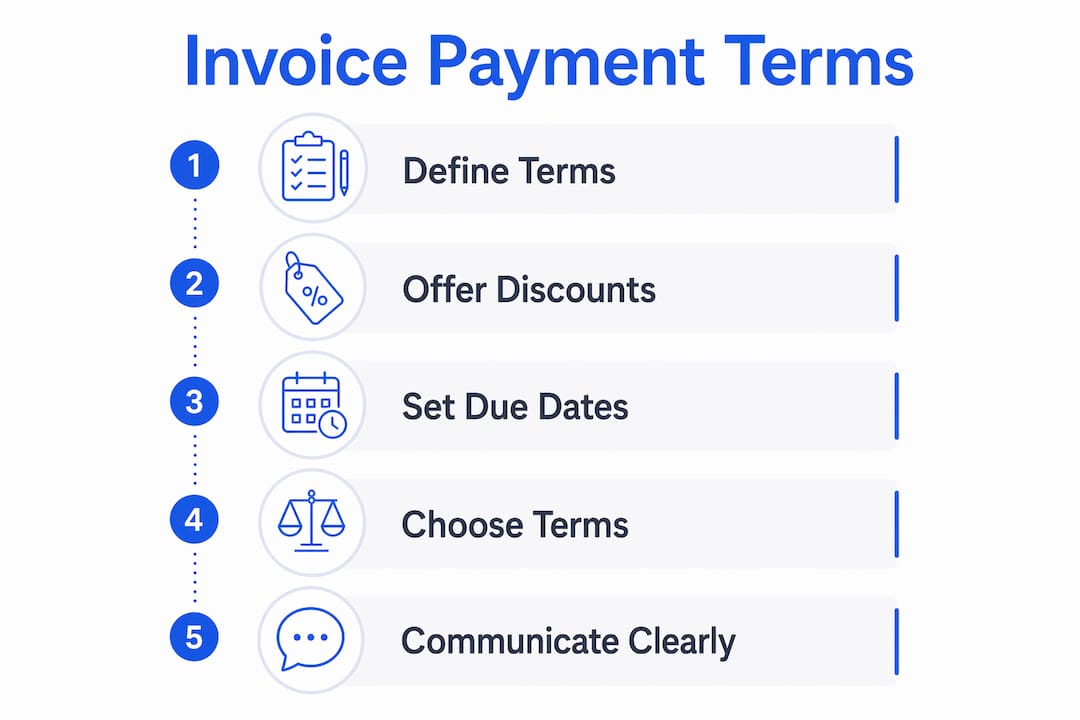
Pro Tip: Instead of writing “Net 30” alone, write the actual due date on every invoice. “Payment due by March 31, 2026” removes all ambiguity. Some clients read Net 30 from the invoice date; others count from when they received it. A full written due date eliminates that confusion entirely.

One more distinction worth knowing: an invoice is a request for payment, not a confirmation that payment has been made. Many providers omit clear due dates, which causes clients to default to a vague 30-day assumption. That assumption costs you money.
How do payment terms affect your cash flow?
The payment terms you set directly control when money lands in your account. Clear payment terms reduce the gap between when you expect payment and when it actually arrives. Vague or missing terms do the opposite.
Here is what that looks like in practice:
- A freelance designer who uses Net 30 on every invoice waits an average of a full month per project before seeing any money. If they complete four projects in January, they may not collect until late February or March.
- A photographer who requires 50% CIA and 50% on delivery collects half before lifting a camera. Their cash flow is protected from the start.
- A consultant who uses 2/10 Net 30 gives clients a reason to pay fast. Many corporate clients will take that discount, which means the consultant gets paid in 10 days instead of 30.
“Starting with lax terms makes tightening them later difficult.” The same logic applies in reverse: starting strict gives you room to relax terms as trust builds, without ever feeling like you are losing ground.
The relationship side matters too. Clients who receive clear, professional invoices with explicit due dates tend to pay faster and dispute less. Ambiguity breeds delay. A client who is unsure when payment is due will often wait until they are asked. Clear terms remove that excuse entirely.
Pro Tip: Start new client relationships with shorter or stricter terms, such as Net 15 or 50% upfront. Adjust terms as trust builds rather than starting loose and trying to tighten later. It is much easier to offer flexibility as a reward than to take it away as a correction.
Which payment terms should you use and when?
Choosing the right payment term depends on your client type, project size, and how well you know the person writing the check. This comparison gives you a practical starting point.
| Payment Term | Best For | Trade-Off |
|---|---|---|
| Net 15 | Established clients, small invoices | Fast collections; some clients push back |
| Net 30 | Standard B2B work, corporate clients | Most widely used B2B term in the U.S.; slower cash flow |
| COD | One-time clients, delivery-based work | Immediate payment; requires in-person or digital setup |
| CIA | New clients, custom or high-risk projects | Maximum protection; may deter price-sensitive clients |
| 2/10 Net 30 | Clients who pay slowly but reliably | Speeds up collections; small discount cost |
| 50/25/25 | Long projects with milestones | Milestone-based payments reduce risk across the project |
Here is how to decide which term fits your situation:
- New client, unknown payment history: Start with CIA or at least 50% upfront. You have no data on how they pay. Protect yourself first.
- Repeat client with a solid track record: Net 15 or Net 30 is reasonable. You have earned enough trust to extend credit.
- Large corporate client with a formal accounts payable process: Net 30 is the industry standard. Pushing for Net 15 is fine, but expect some negotiation.
- Project-based work with multiple phases: Use a milestone structure like 50/25/25 or 40/30/30. This keeps cash coming in throughout the project rather than all at the end.
- Client who consistently pays late: Offer 2/10 Net 30 to incentivize speed, or tighten to Net 15 at the next contract renewal.
Industry norms vary. Consulting and creative services often use Net 30. Construction commonly uses milestone payments. Retail and food service frequently use COD. Knowing your industry’s baseline helps you set terms that feel normal to your clients while still protecting your cash flow.
Pro Tip: When specifying payment terms in digital invoices or online billing systems, clear payment term language in your invoice template prevents disputes before they start. A one-time setup saves you dozens of awkward conversations.
Common mistakes that hurt your collections
Most payment delays are not caused by bad clients. They are caused by unclear invoices. These are the mistakes that cost small service providers the most money.
- Leaving out the due date entirely. Writing only “Net 30” without a calendar date invites misinterpretation. Always include the exact date.
- Assuming clients know what your terms mean. Not every client understands that Net 30 starts from the invoice date. Spell it out in plain language on the invoice itself.
- Skipping late payment consequences. If there is no stated penalty for paying late, there is no urgency. A simple line like “1.5% monthly fee on overdue balances” changes behavior.
- Forgetting early payment incentives. A 2% discount for paying within 10 days costs you very little and can cut your average collection time significantly.
- Never updating your terms. The terms you set with a new client in year one should not be the same terms you use in year three. As relationships mature, your terms should reflect the trust you have built.
Automated invoicing tools address most of these problems directly. When your invoicing platform automatically calculates and displays the due date, includes your late fee policy, and sends payment reminders, you remove the human error that causes most of these mistakes. You also look more professional, which matters more than most small providers realize.
Key takeaways
Clear, specific invoice payment terms are the single most effective way for small service providers to protect their cash flow and reduce payment delays.
| Point | Details |
|---|---|
| Define terms precisely | Always write the full due date on every invoice, not just “Net 30.” |
| Start strict with new clients | Use CIA or 50% upfront with new clients, then relax terms as trust builds. |
| Use incentives to speed payment | A 2/10 Net 30 discount gives clients a reason to pay in 10 days instead of 30. |
| Match terms to the situation | Net 30 fits corporate clients; COD and CIA fit new or high-risk relationships. |
| Automate for consistency | Invoicing tools remove human error and keep your terms clear and professional. |
Why I think most small providers set terms too late
Here is what I have seen over and over: small service providers send an invoice, wait, follow up, wait again, and then wonder why cash flow feels unpredictable. The problem almost never starts at the follow-up stage. It starts at the invoice itself.
Most providers I have talked to set their payment terms as an afterthought. They focus on the work, the price, and the relationship. The terms are whatever feels polite at the time. That is a mistake that compounds quickly.
The providers who manage cash flow well treat payment terms the same way they treat pricing. They decide in advance, they communicate clearly, and they do not apologize for it. A due date is not a demand. It is a professional agreement. Clients who respect your work will respect your terms.
The other thing I have learned: starting strict is almost always the right call. You can always loosen terms as a relationship matures. That feels like generosity. Tightening terms after the fact feels like punishment, even when it is completely justified. Set the right terms from day one and you never have to have that awkward conversation.
Digital tools make this easier than it has ever been. When your invoice automatically shows the due date, your payment policy, and a clear payment link, the conversation is already done before the client even opens the email. That is the kind of setup that actually changes your collections.
— Carrie Cash
Stop chasing payments. Let Tendr.me do the work.
If you are still sending invoices through Cash App, Venmo, or a spreadsheet, you are making your billing harder than it needs to be. Those tools fragment your records and make it nearly impossible to track who owes what and when.
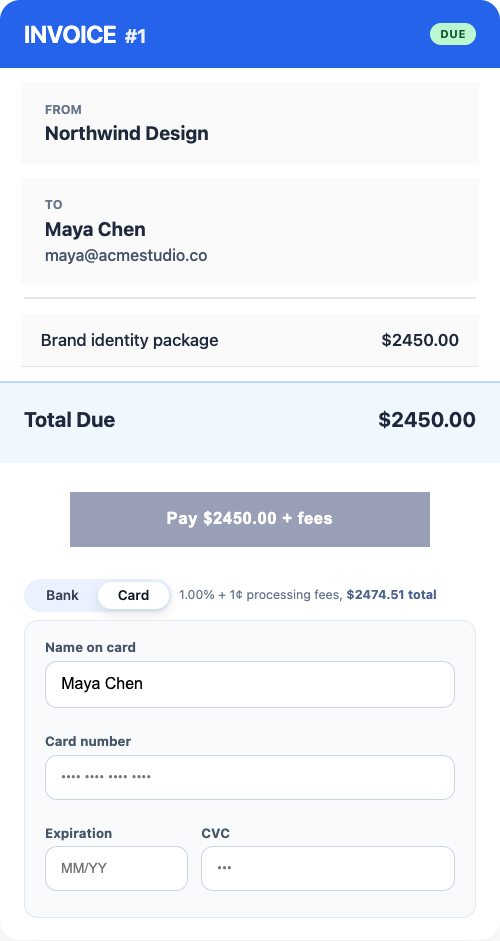
Tendr.me is a completely free invoicing and payment platform built for small service providers. It displays your payment terms and due dates clearly on every invoice, keeps your transaction history in one place, and helps you look professional from the first invoice you send. No accounting degree required. No monthly fee. Just clean, simple billing that works. Try Tendr.me and stop wondering when you are getting paid.
FAQ
What does “net 30” mean on an invoice?
Net 30 means payment is due within 30 calendar days of the invoice date. It is the most widely used B2B payment term in the United States.
What is the difference between COD and CIA?
COD (Cash on Delivery) requires payment at the moment of delivery. CIA (Cash in Advance) requires payment before work begins. CIA offers the most protection for the service provider.
What does 2/10 net 30 mean?
It means the client receives a 2% discount if they pay within 10 days. Otherwise, the full invoice amount is due within 30 days. It is a common way to speed up collections without demanding faster terms outright.
How do milestone payment structures work?
Milestone terms like 50/25/25 split the total payment into stages tied to project progress. The client pays 50% upfront, 25% at a midpoint, and 25% on completion. This keeps cash flowing throughout a long project rather than only at the end.
Should I write the due date or just the payment term on my invoice?
Write both. Include the term (such as Net 30) and the exact calendar due date. Different clients interpret “Net 30” differently, and a specific date removes all guesswork.