Payment Request vs Bill: What Freelancers Need to Know

A payment request is a request for money sent to a client, often with a direct way to pay. A bill is a more casual, consumer-facing label for a similar demand. An invoice is the formal, documented version built for professional records. Knowing the difference helps freelancers communicate more clearly, choose the right tool for the job, and avoid avoidable delays when it is time to get paid.
What is a payment request vs bill, and why does it matter?
A payment request is any communication that asks someone to pay for goods or services. That includes everything from a formal invoice to a quick payment link sent by text or email. The common thread is simple: payment has not happened yet.
A bill fits under that broad umbrella, but it usually reads more informally and more consumer-facing. Think restaurant checks, utility statements, or recurring subscription notices. A bill generally shows an amount due and expects payment without much extra documentation.

An invoice sits at the formal end of the spectrum. It usually includes line items, dates, tax information, and explicit payment terms. For freelancers and small businesses, that formality matters because it creates a cleaner record and gives the client’s accounting process something concrete to work with.
A simple way to frame it: a bill says “you owe this.” A payment request says “here is what you owe and here is how to pay.” An invoice says “here is a documented business record of what you owe and when.”
How payment requests and bills differ in practice
The differences between a payment request and a bill show up most clearly in formality, speed, and documentation.
| Feature | Payment Request | Bill | Invoice |
|---|---|---|---|
| Formality | Low to medium | Low | High |
| Typical context | Freelance, small business, digital | Utilities, restaurants, subscriptions | B2B, contracts, professional services |
| Payment timing | Flexible or immediate | Usually immediate | Often Net 15, 30, or 60 |
| Legal enforceability | Limited | Limited | Stronger |
| Tax documentation | Sometimes | Rarely | Expected |
| Itemization | Optional | Minimal | Expected |
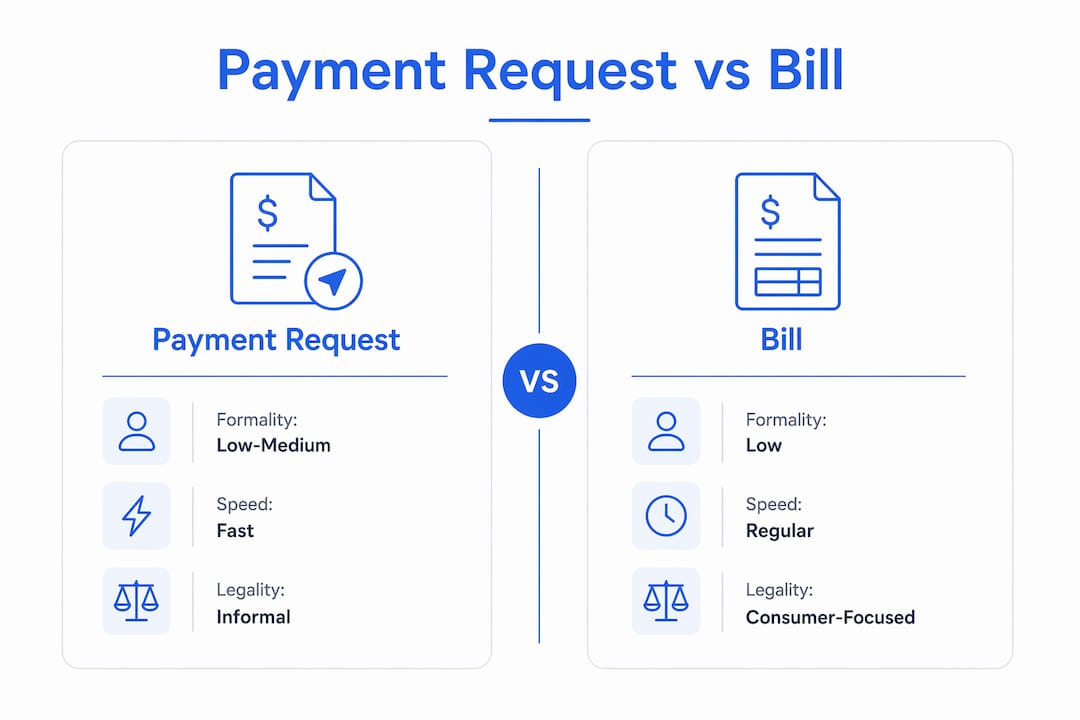
Payment requests prioritize speed. They often arrive with a clickable link or QR code so the client can pay immediately without extra back-and-forth. Bills are more often built around recurring consumer relationships. Invoices are built for accountability and recordkeeping.
Real-world examples for freelancers and small businesses
Knowing the definitions is one thing. Knowing when to use each format is what actually helps in the real world.
When a payment request makes sense:
- A designer sends a client a payment link for a deposit before work begins
- A contractor requests a draw payment mid-project through a digital billing tool
- A freelancer wants to collect quickly through a mobile-friendly link
When a bill is appropriate:
- A subscription service charges a consumer every month
- A restaurant presents a check at the end of a meal
- A utility provider sends a monthly statement
When an invoice is the right call:
- A freelancer bills a business client under a contract
- A consultant needs itemized records and tax documentation
- Any engagement where payment terms need to be explicit and traceable
One common mistake is sending a casual “bill” to a business client that expects an invoice. Larger clients often route payments through accounts payable systems, and those systems are built around formal invoice handling, not vague email asks.
Pro Tip: For business clients, put “Invoice #[number]” in the email subject line. It makes the request easier to process and reduces the chance that it gets buried.
Digital tools that handle payment requests and bills
Modern tools blur the line between payment requests and bills, but they are still optimized for different workflows.
1. Payment request tools
These are built for speed. You create a request, send a link, and the client can pay right away. For many freelancers, this is the fastest path to collecting a deposit or one-off payment.
2. Recurring billing systems
These are built for repetition. They are useful when the same type of charge goes out on a predictable schedule, like a membership or subscription.
3. Formal invoicing platforms
These tools focus on itemization, dates, terms, and proper records. They are usually the better choice when the client is a business and the transaction needs to hold up inside a bookkeeping or audit trail.
Pro Tip: For most freelancers, a purpose-built billing tool beats stitching together consumer payment apps. You get a clearer paper trail, better presentation, and fewer payment follow-up headaches.
Choosing the right document for your situation
The right choice comes down to three things: how formal the relationship is, how much documentation you need, and how quickly you want payment to happen.
- Quick one-time payment from a known client? A payment request link is often enough.
- Recurring consumer service? A bill or recurring billing system fits naturally.
- Business client or contracted work? Use an invoice.
- Not sure what the client expects? Ask directly before you send it.
Consistency matters too. If you call something a bill in one email and an invoice in the next, clients can get confused. Pick the right term for the relationship and use it consistently across the document, the subject line, and the follow-up.
Pro Tip: Build a standard workflow by client type. Business clients get a numbered invoice. Individuals and quick-pay scenarios get a clean payment request. That removes guesswork every time you bill.
Key takeaways
A payment request and a bill both ask for money, but they are not the same thing in practice. For freelancers, the right format depends on the client and the level of documentation the job requires.
| Point | Details |
|---|---|
| Payment request vs bill | Payment requests are flexible and fast; bills are informal and consumer-facing. |
| Invoices are the formal standard | Use invoices for contracts, business clients, and any transaction requiring documentation. |
| Subject line matters | “Invoice #[number]” makes payment emails easier for business clients to process. |
| Digital tools close the gap | Platforms like Tendr.me let you send professional requests without heavyweight accounting software. |
| Match the document to the client | Business clients usually need invoices; individuals often do fine with a clean payment link. |
Why I think most freelancers are using the wrong word
A lot of freelancers treat payment terminology like a tiny wording choice that does not matter. In practice, it changes how clients interpret the request. A business client expects process. A consumer client expects simplicity. If you send the wrong format to the wrong audience, you create friction that did not need to exist.
My recommendation is simple: default to “invoice” for business clients, use payment requests when speed and convenience matter most, and avoid casually calling everything a bill. The term carries the wrong tone in professional service work.
— Carrie Cash
Stop chasing payments. Start using Tendr.me.
If you are still collecting through Cash App, Venmo, or Zelle, you already know the trade-off: fast payments, but messy records and a workflow that never quite feels professional.
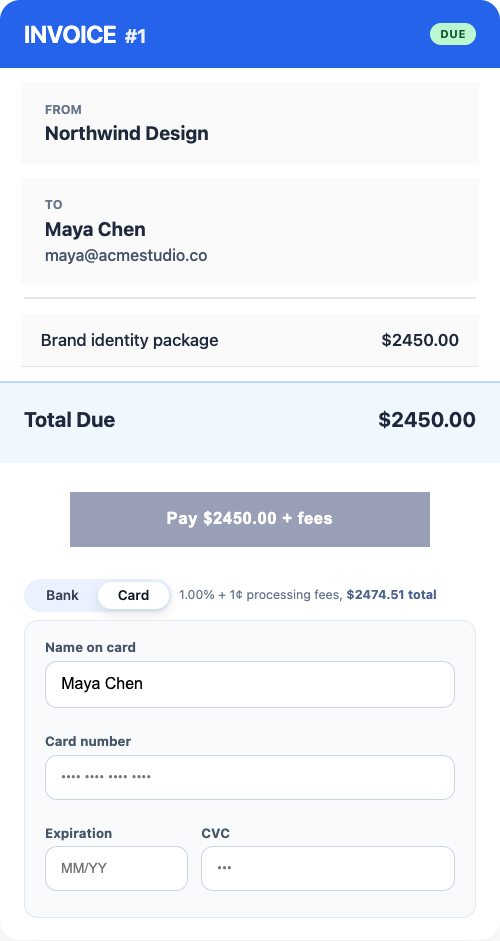
Tendr.me is a free billing platform built for freelancers and small service providers. You can send professional payment requests, keep cleaner records, and see what has been paid and what is still outstanding, all in one place.
FAQ
What is the difference between a payment request and a bill?
A payment request is a communication asking for payment, often with an embedded link or QR code for fast collection. A bill is an informal, consumer-facing term for a similar demand, typically used in utilities, restaurants, or subscriptions.
Is an invoice the same as a payment request?
An invoice is a formal subset of a payment request. Invoices include itemized details, payment terms, and tax information, making them legally enforceable. A payment request may lack those details but can move money faster.
When should a freelancer use an invoice instead of a payment request?
Use an invoice whenever you are working with a business client, fulfilling a contract, or need tax documentation. Use a payment request for quick, one-time transactions where speed matters more than formal records.
What is a bill vs a receipt?
A bill requests payment before it is made. A receipt confirms payment after the transaction is complete. They are not interchangeable, even though people sometimes use the terms loosely.
How do I send a payment request professionally?
Include your business name, the amount owed, a description of services, and a payment link or clear instructions. Use “Invoice #[number]” in your email subject line to make sure business clients process it correctly.