What Does Payment Due Date Mean for Your Invoice?

A payment due date is the specific calendar date by which a financial obligation must be settled to avoid late fees or penalties. It is the contractual deadline that anchors your entire payment cycle, whether you are paying a vendor invoice, a credit card bill, or a contractor you hired last week. For small business owners and independent service providers, understanding what a payment due date actually means is the difference between healthy cash flow and a pile of avoidable late charges. Terms like Net 30 and Net 60 are common shorthand, but they only help when everyone understands how they map to a real calendar date.
What does payment due date mean on an invoice?
A payment due date is the firm deadline printed on an invoice or billing statement by which the payer must submit funds. It is the anchor point for every financial obligation in a billing cycle.

Payment terms like Net 30 start counting from the invoice date, which makes accurate invoice dating critical. If you send an invoice on June 1 with Net 30 terms, the payment deadline is July 1. Miss that date, and the invoice is technically late, regardless of whether a grace period exists.
Common payment terms you will see on invoices include:
- Net 30: Full payment due 30 days from the invoice date
- Net 60: Full payment due 60 days from the invoice date
- Due on receipt: Payment expected immediately upon receiving the invoice
- 1/10 Net 30: A 1% discount if paid within 10 days; otherwise, full payment is due within 30 days
That last term is worth understanding. The “1/10” part is an early-payment incentive. It ties a financial reward directly to the due-date structure, which is a practical way to encourage faster payment without demanding it.
Pro Tip: Always write the explicit calendar date on your invoices alongside the payment term. “Net 30” requires the client to do math. “Due by July 1, 2026” does not.
How does a payment due date differ from a grace period?
The payment due date and the grace period are not the same thing, and confusing them is one of the easiest ways to get surprised by a late fee.
The due date is the contractually required payment date. The grace period is extra time a lender or vendor may allow before they apply a late fee. The grace period does not move the due date. Your payment is still technically late the moment the due date passes.
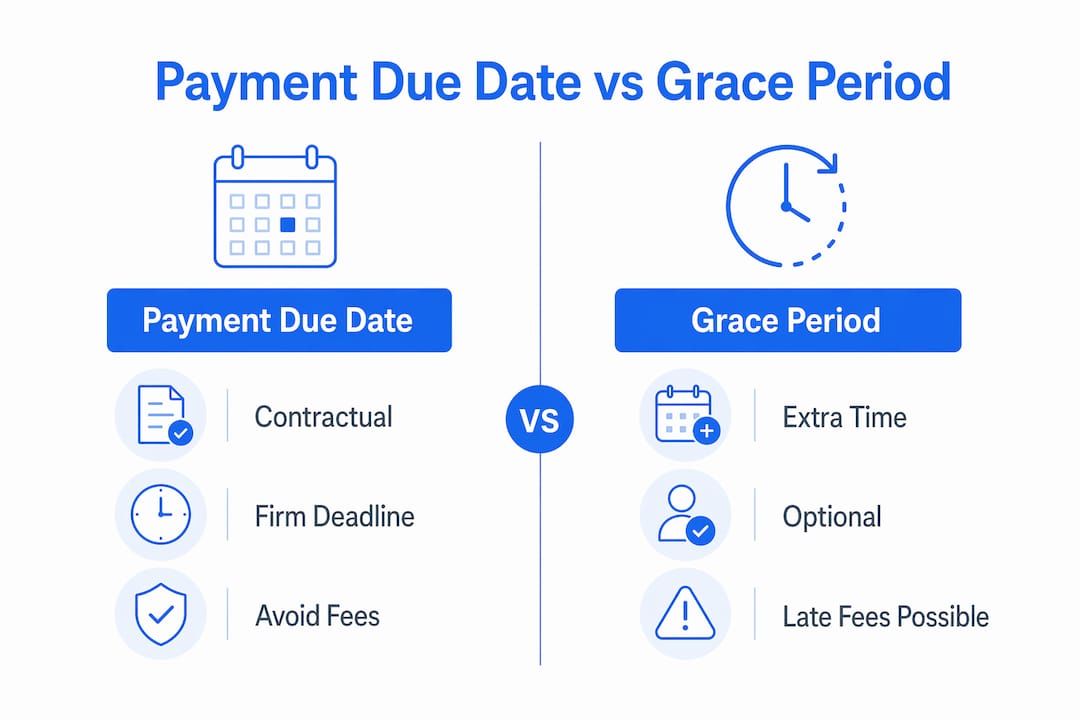
Here is a clear comparison of the key dates in a typical billing cycle:
| Term | Definition | Implication |
|---|---|---|
| Statement closing date | The last day of a billing period | Determines what charges appear on your bill |
| Payment due date | The firm deadline for payment | Missing it means you are late, even if no fee applies yet |
| Grace period end date | The last day before a late fee is charged | Not a second due date; just a buffer before penalties hit |
| Late fee date | The day a penalty is officially applied | Triggered after both the due date and grace period pass |
For credit cards, the statement closing date and the payment due date are separate by design. Your statement closes on one date, and you typically have 21 to 25 days after that to pay. That window is not a grace period. It is your actual payment window, and the due date falls at the end of it.
Pro Tip: Never treat a grace period as extra time you are entitled to. Treat the due date as the real deadline. The grace period is a safety net, not a schedule.
Why explicit calendar dates on invoices matter
Explicitly stating a calendar payment due date on invoices reduces ambiguity, prevents late payments, and improves cash-flow management. The reason is simple: you remove the calculation burden from your client.
When you write “Net 30” on an invoice, you are asking the client to identify the invoice date, count 30 days forward, and land on the correct deadline. That introduces multiple chances for error. When you write “Due by August 15, 2026,” there is nothing to calculate.
Here is what vague payment terms actually cost you:
- Disputes over start dates. Clients sometimes count from the date they received the invoice, not the date you issued it.
- Delayed payments from honest confusion. Some clients genuinely miscalculate Net 30. They are not stalling; they just got the math wrong.
- Cash-flow gaps you did not plan for. A handful of clients paying just a few days late can throw off your receivables more than you expect.
- Awkward collection conversations. Chasing a payment is uncomfortable. Chasing one where the client disputes the due date is worse.
Clear, mutually agreed payment terms align expectations and support predictable cash flow, which is what every small business needs to plan ahead with confidence. The fix is straightforward: write the date out every time.
How to track and meet payment due dates without the stress
Staying on top of payment deadlines does not require a full accounting stack. It requires a consistent habit and the right tooling.
- Record every due date the moment an invoice is issued or received. Do not rely on memory. Add it to your calendar with reminders.
- Set two reminders per invoice. One a few days ahead, one the day before. That catches most misses before they happen.
- Document payment terms in writing before work begins. A short email confirmation is often enough to prevent future disputes.
- Use a digital invoicing platform instead of consumer payment apps. Cash App, Venmo, and Zelle move money, but they do not give you due-date tracking, reminders, or clean dispute records.
- Follow up on overdue invoices within 24 hours of the due date. The longer you wait, the harder the conversation gets.
Pro Tip: If a client disputes a due date, go back to the original invoice and written agreement. That documentation is your source of truth.
If you bill on a recurring basis, a weekly review is worth building into your routine. Check what is outstanding, what is due in the next seven days, and what is already overdue. That 15-minute habit prevents most cash-flow surprises.
Key takeaways
A payment due date is the firm contractual deadline on an invoice or bill, and treating it as anything less than that is the root cause of many late-payment problems.
| Point | Details |
|---|---|
| Payment due date defined | It is the specific calendar date by which payment must be received to avoid penalties. |
| Due date vs. grace period | The grace period does not extend the due date; it only delays the late fee. |
| Use explicit calendar dates | Writing “Due by [date]” removes calculation errors and reduces late payments. |
| Document terms upfront | Written agreement on payment terms prevents disputes before they start. |
| Use digital tools | Invoicing platforms with reminders improve on-time payment rates for small businesses. |
The one thing most small business owners get wrong about due dates
A lot of small business owners treat payment terms like a formality. They slap “Net 30” on an invoice because that is what they have seen elsewhere, without thinking about whether the client actually knows what that means or when the clock starts.
The real problem is usually not that clients are trying to pay late. It is that vague terms create a gap between what the seller expects and what the buyer understands. That gap costs money.
The other common mistake is waiting too long to follow up after the due date passes because it feels pushy. It is not. A short, professional follow-up the day after a missed deadline is just good business.
Write the calendar date on every invoice, confirm terms before work starts, and follow up quickly when a deadline passes. Those three habits do more for cash flow than most people expect.
— Carrie Cash
Stop chasing payments. Start using Tendr.me.
If managing due dates, sending reminders, and keeping track of who has paid feels like a second job, you are not alone. Many small service providers are still stitching invoices together across consumer payment apps, text messages, and spreadsheets.
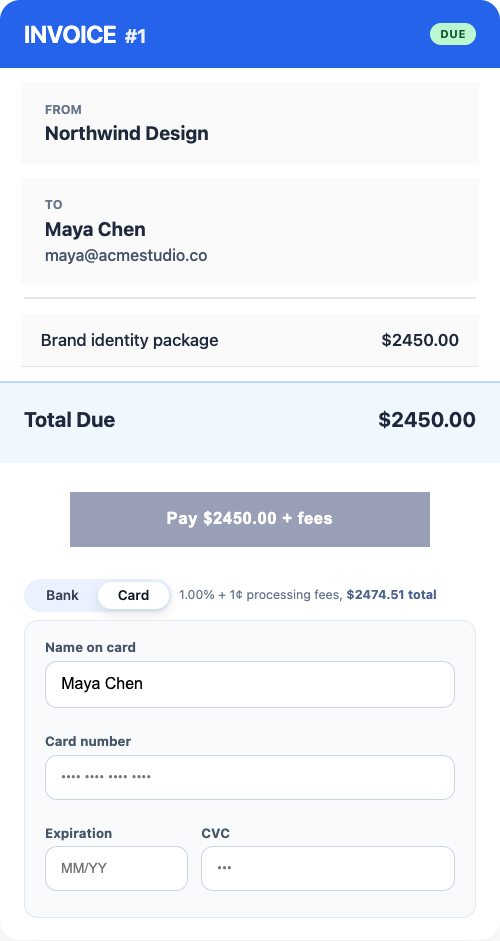
Tendr.me is a free invoicing platform built for small businesses and independent service providers. You can set explicit payment due dates on every invoice, track what is paid and what is outstanding, and keep your records clean without needing a full accounting background. No subscriptions. No complexity. Just a professional way to request payment and stay on top of it.
FAQ
What does “payment due date” mean on an invoice?
The payment due date is the specific calendar date by which the payer must submit funds to meet their obligation. Missing it means the payment is late, even if no fee is charged immediately.
Is the grace period the same as the payment due date?
No. The due date and grace period are separate. The due date is the contractual deadline; the grace period is extra time before a late fee applies, but your payment is still considered late after the due date passes.
How is a payment due date calculated for Net 30 terms?
The due date is calculated by adding 30 days to the invoice date. If your invoice is dated July 1, the payment deadline is July 31.
Why should I write a calendar date instead of “Net 30” on invoices?
Writing an explicit date like “Due by July 31, 2026” removes the need for the client to calculate the deadline. Explicit calendar dates reduce miscalculations and late payments for small businesses.
What happens if a client misses the payment due date?
Once the due date passes, the payment is technically late. If a grace period applies, a late fee is not charged until that window closes. Follow up within 24 hours of a missed deadline to keep the process moving and protect your cash flow.