Billing Mistakes Landscaping Businesses Must Fix Now

Billing mistakes in landscaping are not small admin errors. They are the kinds of invoicing problems that delay payment, trigger disputes, and quietly drain cash out of a service business. The good news is that most of them are fixable with a better workflow, clearer invoices, and faster follow-through.
1. Common billing mistakes landscaping businesses make with invoice timing
Delayed invoicing is one of the most expensive billing mistakes a landscaping business can make. When an invoice shows up days later, the client remembers less, questions more, and pays slower. That lag creates what is effectively a recollection gap: the work is done, but the details are already fading.
Practical fixes are simple:
- Send invoices the same day the job is complete
- Use a mobile billing workflow instead of waiting to get back to the office
- Set a rule that no job closes without an invoice going out
Pro Tip: If you finish a job on Friday afternoon, send the invoice before the drive home. The fresher the work is in the client’s mind, the easier it is to get paid without friction.
2. What vague invoice descriptions cost you

Vague line items create disputes. A charge like “Lawn service — $350” gives the client very little to anchor to. A better invoice shows what work was done, when it was done, and what materials were used.
Clear itemization also matters for tax handling and recordkeeping. Separating labor and materials makes the invoice easier for both the client and your own books to understand.
Better itemization looks like this:
- Labor: mowing, edging, and blowing, including hours or flat scope
- Materials: mulch, seed, or other billable materials listed separately
- Service date: written explicitly
- Job address: included separately from the billing address when relevant
Pro Tip: Create standard line-item templates for your recurring services so each invoice starts structured and only needs the specifics filled in.
3. Why missing payment terms invite slow payments
If you do not define the payment window, the client will define it for you. That usually means slower cash flow than you want.
Explicit terms work better when written as both a policy and a real date. “Net 14” is useful, but “Payment due by June 26, 2026” is even clearer for clients who do not think in billing shorthand.
- State the due date directly.
- Put any late fee in plain language.
- Explain what happens if payment remains overdue.
- List the preferred payment method clearly.
Once a client gets used to paying late without consequences, late payment becomes the norm. Clear terms prevent that habit from forming.
4. What payment options accelerate collections
Paper checks slow down the whole cycle. Online payment links, card payments, and ACH options remove friction and shorten the gap between sending an invoice and receiving money.
The goal is simple: minimize the number of extra steps between “invoice received” and “payment sent.” That usually means:
- Card payments through a payment link
- ACH transfers for repeat clients
- Mobile-friendly payment flows that work cleanly from a phone
For landscaping businesses that want a cleaner system, payment tracking for landscapers works better when it is built into the invoicing workflow instead of bolted on afterward.
5. How automation prevents revenue leakage
Manual billing makes it harder to see what has been sent, what has been viewed, what is overdue, and what still needs follow-up. That lack of visibility is where revenue leakage starts.
| Billing method | Invoice visibility | Overdue tracking | Payment speed |
|---|---|---|---|
| Manual spreadsheet or paper | Low | Manual | Slowest |
| Consumer payment apps | Fragmented | Minimal | Moderate |
| Dedicated billing software | Real-time | Automated | Fastest |
Weekly review cycles also help. When you check receivables every week instead of every month, overdue accounts surface earlier and become easier to manage.
Pro Tip: Use a billing system that shows invoice status at a glance. If you need memory and scattered apps to know who has paid, the system is already failing you.
6. The problem with using consumer payment apps for business billing
Cash App, Venmo, and Zelle are convenient, but they are not a real billing system for a landscaping business. They fragment payment history, weaken your paper trail, and make reconciliation more manual than it needs to be.
A proper invoice with a payment link feels more professional, keeps your records in one place, and makes it easier for the client to treat the payment as a business obligation instead of a casual transfer.
7. How to handle client disputes caused by billing errors
Most landscaping billing disputes come back to two preventable issues: late invoices and unclear invoices. The faster way to resolve them is to keep the right documentation ready before the client asks.
Photos of completed work, service dates, notes about materials, and a clean invoice record make disputes much easier to close quickly. It also helps to maintain a usable client payment history so you can spot repeat patterns instead of treating every problem like a first-time surprise.
Key takeaways
Billing mistakes in landscaping are usually a systems problem. Tighten the system and payment improves.
| Point | Details |
|---|---|
| Invoice quickly | Prompt invoicing shortens the recollection gap and improves payment speed. |
| Itemize clearly | Separating labor and materials reduces confusion and keeps records cleaner. |
| Use explicit payment terms | Clients pay more predictably when the due date and consequences are obvious. |
| Offer online payments | Payment links reduce friction and shorten the collection cycle. |
| Automate visibility | Seeing invoice status in one place prevents avoidable leakage and missed follow-up. |
Billing is a revenue protection system, not paperwork
Landscaping businesses do not usually struggle because the work is bad. They struggle because the billing system is too loose. When invoicing depends on memory, energy, or “catching up later,” it breaks down. The best fix is not more willpower. It is a workflow that makes invoicing automatic and visible.
That is why good billing behaves more like equipment maintenance than office paperwork. It protects the revenue engine. If the process is reliable, the cash flow becomes more reliable too.
— Carrie Cash
Stop chasing payments. Start using Tendr.me.
If billing is still the messiest part of your week, it does not have to stay that way. Tendr.me gives small service businesses a cleaner way to send invoices, accept payments, and track overdue accounts without the patchwork of consumer apps.
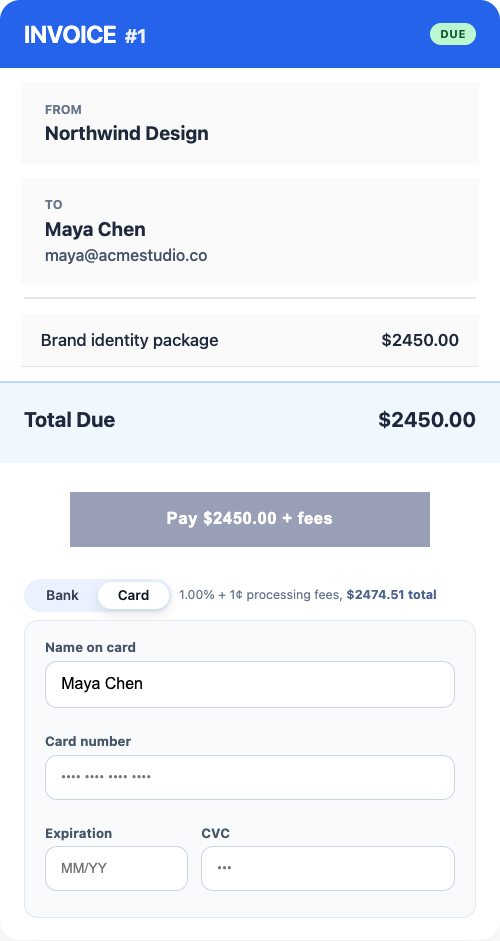
It is free, straightforward, and built for the kind of recurring service work where payment discipline matters.
FAQ
How soon should landscaping businesses send invoices?
Send invoices within 24 to 48 hours of completing the job. Invoicing within that window gets you paid much faster than waiting a week.
What payment terms are standard for landscaping businesses?
Net 14 is a common standard, meaning payment is due 14 days from the invoice date. A 1.5% monthly late fee on balances past 30 days is also common practice.
Why should labor and materials be listed separately on a landscaping invoice?
In many U.S. states, labor and materials are treated differently for tax purposes. Separating them makes invoices clearer for clients and cleaner for compliance.
What causes the most billing disputes in landscaping?
Vague invoice descriptions and delayed invoicing cause many disputes. Clients push back more often when they cannot clearly connect the charge to the work performed.
Do online payment fees outweigh the benefits for landscapers?
Usually no. Faster collection and cleaner records often matter more than the processing fee, especially compared with carrying unpaid invoices for extra weeks.